
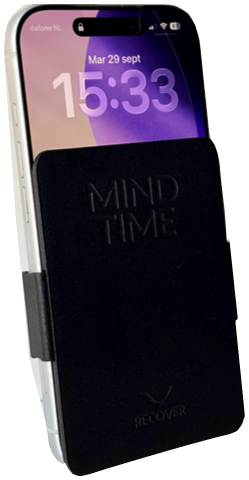
ReCover is built on a simple idea from behavioural science: shape the moment, and the choice gets easier. Here's what the research says — and what it doesn't.
The easiest temptation to resist is the one you don't see.
Most of the time, we don't choose.
Reaching for your phone rarely feels like a decision. Often, it isn't one. In one diary study, around four in ten everyday actions turned out to be habits — things we repeat in the same place, almost daily, often while thinking about something else.1
When researchers checked in with thousands of people at random moments of their day, their minds were somewhere other than what they were doing almost half the time.2
46.9% of waking moments, our minds are elsewhere.2
Your phone isn't the problem. Using it without choosing to is.
Out of sight, easier to resist.
In a series of classic experiments at Stanford, preschoolers were offered a choice: one treat now, or two if they could wait. What helped them wait wasn't character. It was the view.
When the treat sat in front of them, children waited about six minutes on average. When it was covered, they waited more than eleven.3
~6 min Treat in sight
11+ min Treat covered
ReCover does the same for your screen. It takes the pull out of view.
A little friction changes a lot.
You don't have to forbid something to use it less. You only have to make it slightly less immediate.
A Cochrane review — among the most rigorous sources of evidence in health research — found that simply placing food further away reduced how much people ate by around 19%, across twelve studies.4 The same logic holds for screens: when people set their phones to greyscale for a week, they used them about 20 minutes less a day and felt more in control of them.5
19% less consumed, just by adding a little distance.4
ReCover
ReCover adds that friction physically: one small interruption between impulse and action.
Self-control is designed, not forced.
We tend to picture self-control as a battle. The research tells a quieter story.
People with strong self-control don't win more fights with temptation — they arrange their lives so they face fewer. Researchers point out that shaping the situation in advance tends to work better than resisting in the moment.6 Those with more self-control rely more on good habits than on constant effort,7 and they report fewer inner conflicts and greater satisfaction with their lives.8
The most disciplined people aren't fighting harder.
They've made the fight unnecessary.
That's the idea behind ReCover. No willpower battle. Just a better default.
Being here feels better.

The same study that tracked wandering minds found something else. People were less happy when their minds wandered than when they were focused on what they were doing — whatever it was.2
Research on mindful attention points the same way: people who are more aware of the present moment report greater well-being, and act more in line with what they actually value.9
Be where you are.
How ReCover puts it into practice.
One object. Three moments. Four principles.
References
- Wood, W., Quinn, J. M., & Kashy, D. A. (2002). Habits in everyday life: Thought, emotion, and action. Journal of Personality and Social Psychology, 83(6), 1281–1297. https://doi.org/10.1037/0022-3514.83.6.1281 ↩
- Killingsworth, M. A., & Gilbert, D. T. (2010). A wandering mind is an unhappy mind. Science, 330(6006), 932. https://doi.org/10.1126/science.1192439 ↩
- Mischel, W., Shoda, Y., & Rodriguez, M. L. (1989). Delay of gratification in children. Science, 244(4907), 933–938. https://doi.org/10.1126/science.2658056 ↩
- Hollands, G. J., et al. (2019). Altering the availability or proximity of food, alcohol, and tobacco products to change their selection and consumption. Cochrane Database of Systematic Reviews, CD012573. https://doi.org/10.1002/14651858.CD012573.pub2 ↩
- Dekker, C. A., & Baumgartner, S. E. (2023). Is life brighter when your phone is not? The efficacy of a grayscale smartphone intervention. Mobile Media & Communication. https://doi.org/10.1177/20501579231212062 ↩
- Duckworth, A. L., Gendler, T. S., & Gross, J. J. (2016). Situational strategies for self-control. Perspectives on Psychological Science, 11(1), 35–55. https://doi.org/10.1177/1745691615623247 ↩
- Galla, B. M., & Duckworth, A. L. (2015). More than resisting temptation: Beneficial habits mediate the relationship between self-control and positive life outcomes. Journal of Personality and Social Psychology, 109(3), 508–525. https://doi.org/10.1037/pspp0000026 ↩
- Hofmann, W., Luhmann, M., Fisher, R. R., Vohs, K. D., & Baumeister, R. F. (2014). Yes, but are they happy? Effects of trait self-control on affective well-being and life satisfaction. Journal of Personality, 82(4), 265–277. https://doi.org/10.1111/jopy.12050 ↩
- Brown, K. W., & Ryan, R. M. (2003). The benefits of being present: Mindfulness and its role in psychological well-being. Journal of Personality and Social Psychology, 84(4), 822–848. https://doi.org/10.1037/0022-3514.84.4.822 ↩